It is a 26-post library written entirely by the founder, published between 5 July and 27 August 2026, and then abandoned. Twenty of those posts never mention Faymas in the body text at all, and a twenty-first mentions it exactly once. Five are product posts, and they are the short ones — 690 words on average, against 1,340 for the generic tutorials. Not one of the 26 links to a single prompt page, even though the site indexed 11,965 of them on the same day we checked.
This audit reads published pages and metadata only. No account was created and no earnings claim is made.
The blog by the numbers
We pulled the faymas.in sitemap on 1 October 2026 and fetched every editorial URL in it. That is 27 entries: one index page and 26 posts. Then we read each of the 26 in full.
| Measurement | Value | Note |
|---|---|---|
| Posts in the sitemap | 26 | Plus one /blog index page |
| First published | 5 July 2026 | datePublished in page metadata |
| Most recent | 27 August 2026 | 35 days before this check |
| Distinct authors | 1 | Faheem Sheikh, listed as Founder & CEO |
| Body words, all posts | 31,585 | Paragraph text only |
| Shortest / longest | 342 / 3,143 | A 9× spread |
| Posts naming Faymas zero times | 20 of 26 | A 21st mentions it once |
| Internal links to prompts | 0 | Across all 26 posts |
None of this is hidden. It is just never assembled in one place, so the blog reads very differently post by post than it does as a set.
It stopped on 27 August, and the marketplace did not
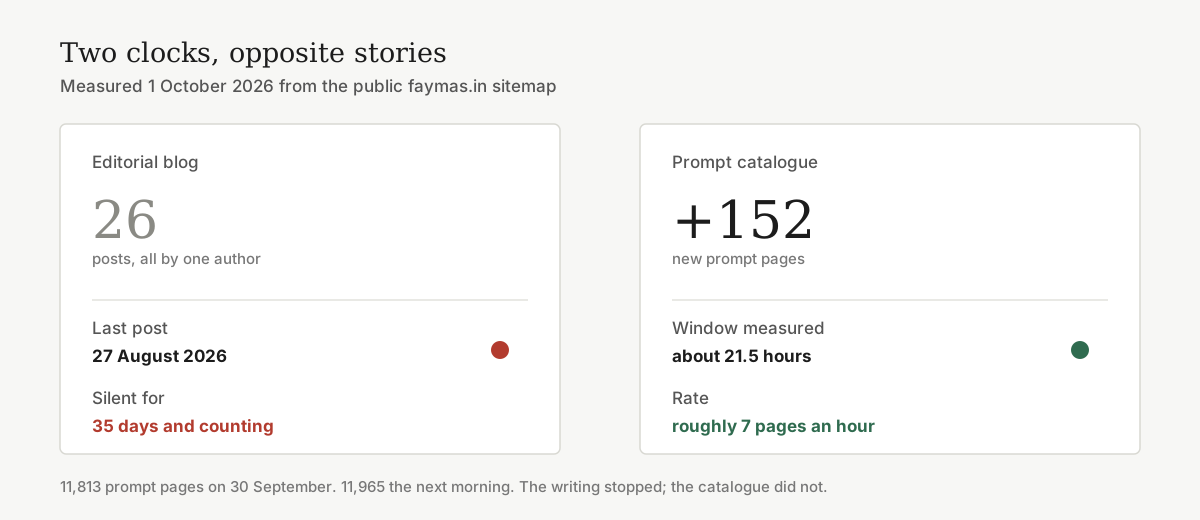
Twenty-four of the 26 posts landed inside a single 28-day burst, 5 July to 1 August. Then there is a 24-day hole, two posts on 25 and 27 August, and nothing since.
Meanwhile the catalogue kept moving. Our sitemap read on 30 September counted 11,813 prompt pages. The next morning it counted 11,965. That is 152 new prompt pages in about 21.5 hours — roughly seven an hour, while the editorial side sat still for five weeks.
Two clocks, running at completely different speeds. If you are trying to judge whether the project is active, the prompt count and the post count currently tell opposite stories, and only one of them is about writing.
Twenty-one posts that never say the word
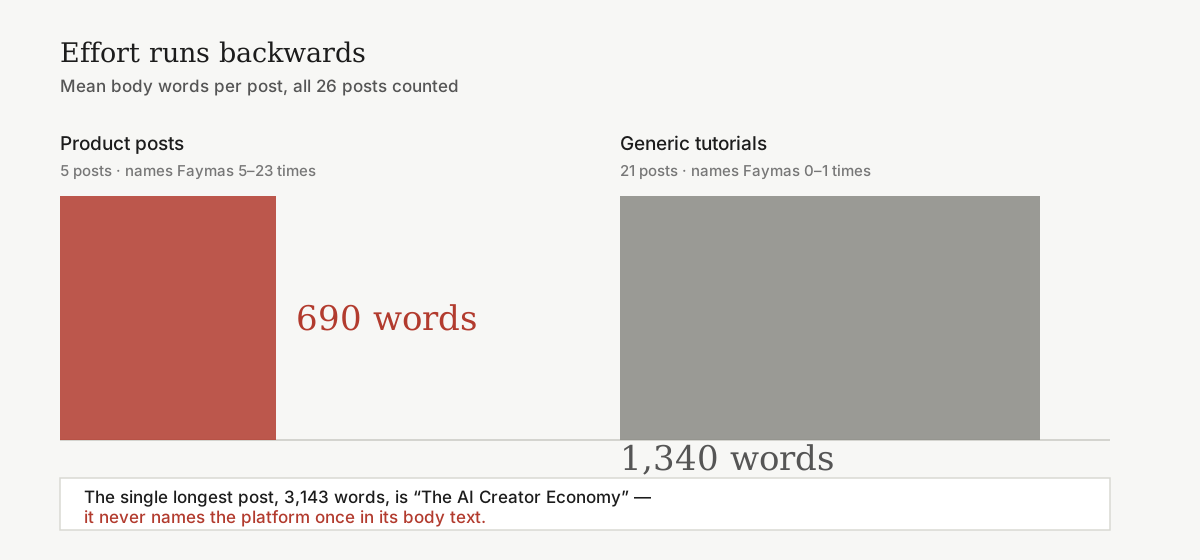
Sort the 26 by how often the body text mentions the product and the split is not gradual. It snaps.
| Group | Posts | “Faymas” in body | Mean length |
|---|---|---|---|
| Product posts | 5 | 5–23 times | 690 words |
| Generic tutorials | 21 | 0–1 times | 1,340 words |
The five product posts are What Is Faymas?, Faymas AI Prompts, Faymas Creator League, How to Earn Money Selling AI Prompts on Faymas, and Top 10 Most Trending Prompts on Faymas Right Now. Everything else — prompt engineering basics, anime art, AI filmmaking, Claude for writing, twelve video generators compared — is generic AI explainer material that happens to carry a Faymas footer.
And the effort runs backwards. The posts about the product average 690 words. The posts about nothing in particular average 1,340, nearly double. The single longest piece, at 3,143 words, is The AI Creator Economy, which does not name the platform once in its body. The shortest, at 342, is a list of common prompt mistakes. Read as a budget, that says the generic search traffic got the long-form investment and the product itself got the leftovers.
The posts are a dead end
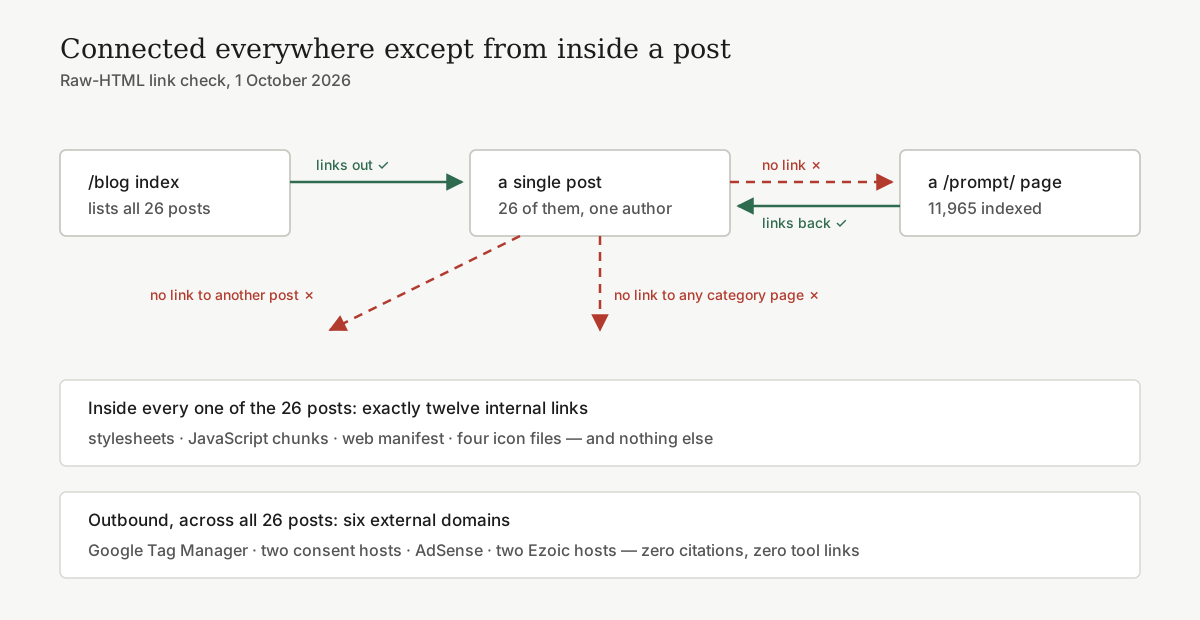
This is the part that surprised us. Each of the 26 posts contains exactly twelve internal links. All twelve, in every post, point at static assets: stylesheets, JavaScript chunks, the web manifest, and four icon files. There is not one link to a prompt page, a category page, another blog post, or even the site navigation.
We checked whether this was a crawling artefact. It is not. The homepage serves 20 /prompt/ links in raw HTML, so content links do render server-side. The /blog index links to all 26 posts. And a prompt page links back to /blog. The graph is connected everywhere except from inside a post: a reader who finishes an article has no clickable route to the marketplace the article is nominally about.
Outbound, the pattern repeats. Across all 26 posts the only external domains are Google Tag Manager, two consent-management hosts, Google AdSense and two Ezoic hosts. Six domains, all ad and analytics infrastructure. Zero citations, zero tool links, zero sources. A 2,464-word comparison of twelve video generators links to none of the twelve.
The two posts that promise evidence and carry none
Top 10 Most Trending Prompts on Faymas Right Now, published 1 August, opens by saying the list is “ranked by actual copy counts from real users” and dismisses competitors for “recycling the same fake examples.” It then describes ten unnamed prompts by look alone — moody editorial portraits, high-contrast film noir, a three-panel fashion collage, a dispersion effect, blue-hour beach editorial, graffiti-backdrop streetwear. No titles. No creator names. No copy counts. No links. It is 508 words long, and it has been sitting under the word “Right Now” for 61 days.
How to Earn Money Selling AI Prompts on Faymas is 498 words. Its central claim is “Every time someone copies your prompt, you earn.” The post contains no dollar figure, no rate per copy, no payout threshold, and no worked example. The only concrete program detail is a mention of a “Founding Creator Program” with no terms attached. Across all 26 posts, exactly one contains dollar amounts at all — and those are competitor subscription prices in the video-generator roundup.
Neither post is wrong. Both are unsupported, which is a different problem and a harder one to notice while you are reading.
One author, no revisions
Every post carries the same byline. That is normal for a founder-led blog in its first months. What is less common is that in all 26 cases the dateModified field is identical to datePublished — down to the second. Not one post has been touched since it went up.
For evergreen explainers that is fine. For posts about model names, tool line-ups and pricing, it is the kind of thing that ages badly and quietly. Any figure quoted in a July post is a July figure wearing no label saying so.
How to read it
Treat the blog as two separate things sharing a URL prefix.
- Use the 21 generic posts as tutorials, not as product information. The prompt-structure and mistake-list material stands on its own and does not depend on Faymas being involved.
- Do not use the 5 product posts as a source of figures. They carry claims without numbers, and we found no rate converting copies into money anywhere on the site.
- Never navigate from a post. If a post makes you want to browse prompts, open the homepage or search directly; the post will not take you there.
- Check the date before trusting any tool comparison. Everything predates 27 August 2026 and none of it has been revised.
- Do not read the silence as shutdown. The catalogue is still adding pages daily. What stopped is the writing, not the platform.
What we could not verify
- Why publishing stopped. No announcement, roadmap or status page exists on the site. We found no statement either way.
- Whether posts are planned to resume. Not stated anywhere we could read.
- Whether any post has ever driven copies or signups. No analytics are public.
- Whether the missing internal links are deliberate. They could be a template gap, a CMS limitation, or a choice. We can only report that they are absent on all 26.
- Earnings of any kind. Faymas publishes no per-copy rate, so no financial claim is made here.
What would change this verdict
Three observable things, all cheap to re-check. A post dated after 27 August 2026. A dateModified that differs from datePublished on any of the 26. Or a single /prompt/ link appearing inside a post body.
Any one of those ends the “stalled and disconnected” reading. Until then the honest summary is narrower than it sounds: the writing stopped, the marketplace did not, and nothing in the blog is wired to the thing it describes.
PromptPlank publishes independently and has no affiliation with Faymas. All figures come from 1 October 2026, roughly 09:05–09:20 UTC+8, by direct fetch of the public sitemap and the 26 public post URLs. No prompt titles or creator names from the marketplace are reproduced here.