There is no long tail under the phrase, and the tail that does exist belongs to a different word. "faymas prompt" draws about 10 US searches a month, and no first-page bid is recorded for it at all. On 8 October 2026 we pulled every URL the three faymas sites publish and searched them for the phrase and its longer forms: of faymas.in's 15,030 URLs, 11 carry both "faymas" and "prompt" in the slug — 0.073%. Of faymas.net's 41 pages, exactly one path contains the brand word. Meanwhile the tail that the biggest faymas site actually sits on adds up to roughly 332,000 searches a month, and not one of the eight keywords in it contains the string "faymas".
This guide analyses published prompt text. No generation tests were run.
What "10 a month" is made of
The keyword data we hold for faymas prompt (US) reads: 10 searches a month, competition low, first-page bid "—". Two of those three fields deserve a second look before you build anything on them.
The 12-month sparkline that came with the number is eleven flat bars followed by one full bar: ▁▁▁▁▁▁▁▁▁▁▁█. A sparkline cannot be read back into monthly values, so we are not going to invent a split. But eleven bars on the floor and one on the ceiling is not the shape a steady query draws. Our reading, and it is an inference not a measurement: 10 a month is an average carried by one recent month, not a baseline you can forecast from.
The bid field is the sharper tell. It shows a dash, not $0.00. Those are different statements. A zero says advertisers bid and bid nothing. A dash says there was too little advertiser activity to model a price. We are inferring that distinction from the field's format; we did not measure any ad platform's threshold, and we are not going to quote one.
Test one: does the biggest faymas library even contain the words?
If a phrase has a long tail, the site that owns the head word is the first place the tail should show up — in URLs, if nowhere else. We pulled faymas.in's /sitemap.xml and counted. It is a big corpus, and it is almost entirely one template.
| Slice | URLs | Share |
|---|---|---|
/prompt/ (individual prompt pages) | 14,970 | 99.6% |
/blog/ | 27 | 0.18% |
/prompts/ (keyword collection pages) | 12 | 0.08% |
/category/ | 11 | 0.07% |
/creator/ | 4 | 0.03% |
| Everything else (home, contact, privacy) | 6 | 0.04% |
Now the two words. Across all 15,030 slugs: 23 contain "faymas" (0.153%), 2,112 contain "prompt" (14.05%), and 11 contain both (0.073%). Separately, 99.6% of slugs end in an eight-character hex suffix — the whole corpus is machine-generated, so the 0.073% is not a deliberate keyword plan. It is what falls out when a generator is told to write titles.
Then we wrote down nine longer forms a person might actually type and grepped the slugs for each.
| Long-tail form | Slug hits across 15,030 URLs |
|---|---|
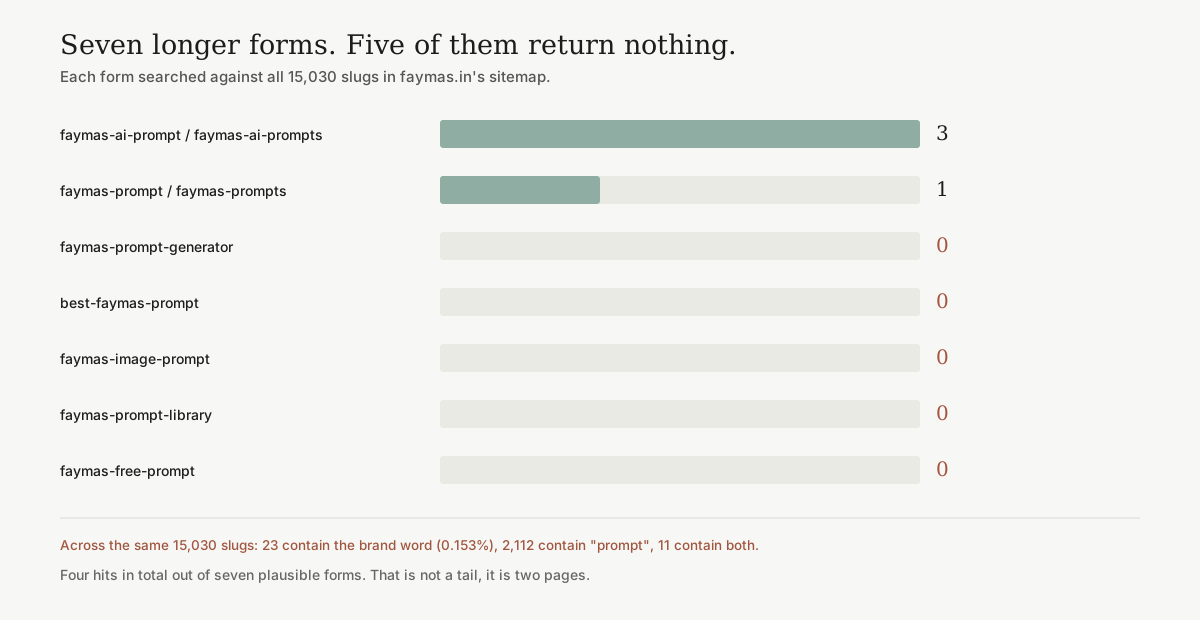
faymas-ai-prompt / faymas-ai-prompts | 3 |
faymas-prompt / faymas-prompts | 1 |
faymas-prompt-generator | 0 |
best-faymas-prompt | 0 |
faymas-image-prompt | 0 |
faymas-prompt-library | 0 |
faymas-free-prompt | 0 |
Five of nine return nothing. Not "few" — nothing, across fifteen thousand URLs. A real long tail leaves a supply trail even when nobody writes for it, because users' own language leaks into titles and tags. This one leaves four hits and a row of zeros.
Test two: does the page that matches the query return anything different?
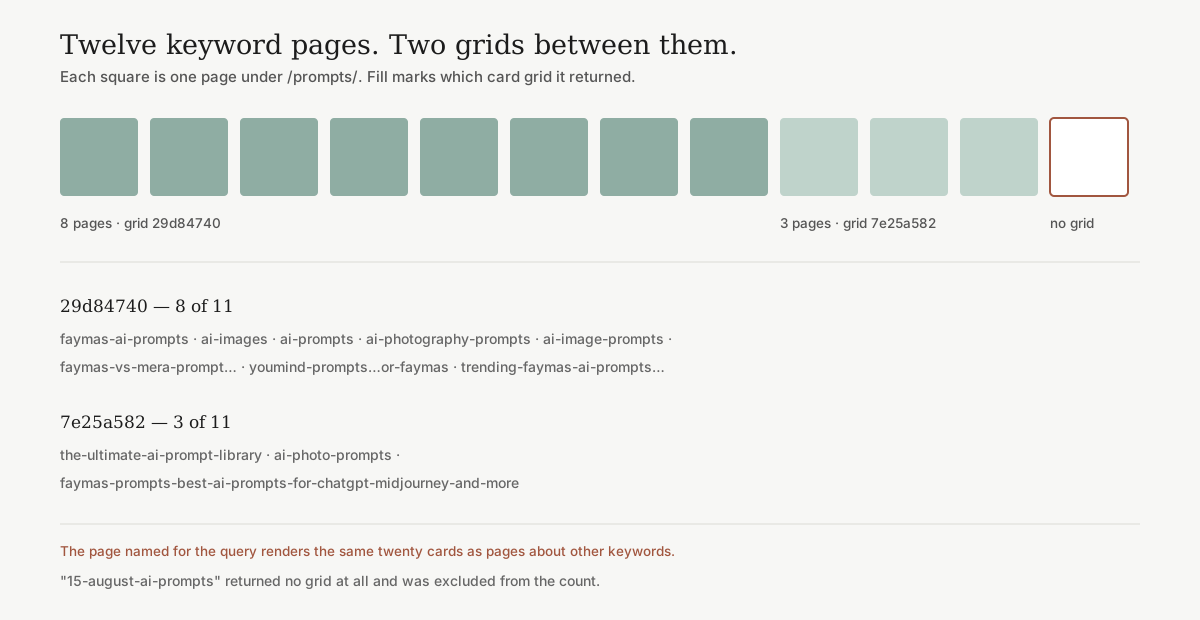
faymas.in keeps 12 keyword collection pages under /prompts/, and one of them is literally named faymas-ai-prompts. That is the page that should answer a "faymas prompt" search. We fetched all 12 and hashed the sequence of prompt slugs each one returned.
Eleven of the 12 came back with a 20-card grid. 15-august-ai-prompts returned no grid at all, so we excluded it. Among the remaining eleven there are exactly two distinct grids.
| Grid signature | Pages sharing it | Includes |
|---|---|---|
29d84740 | 8 of 11 | faymas-ai-prompts, ai-images, ai-prompts, ai-photography-prompts, ai-image-prompts, faymas-vs-mera-prompt…, youmind-prompts…or-faymas, trending-faymas-ai-prompts… |
7e25a582 | 3 of 11 | the-ultimate-ai-prompt-library, ai-photo-prompts, faymas-prompts-best-ai-prompts-for-chatgpt-midjourney-and-more |
Read the first row. The page whose URL is faymas-ai-prompts serves the same twenty items, in the same order, as /prompts/ai-images and /prompts/ai-prompts. The keyword is in the address. It is not in the result set. For control, the homepage grid hashed to d3da2555 — different from both, so this is not a cache artifact.
One caveat we owe you: these grids rotate. An earlier pass the same morning put faymas-ai-prompts on the other signature. The finding survives the rotation, because the finding is not "which signature" — it is that eleven pages share two.
Test three: the product site has built exactly one such page
faymas.net is the small one: 41 URLs, unchanged since we first counted it. Twelve of its paths contain "prompt". Exactly one contains "faymas" — /prompts/faymas-ai-prompts.
And unlike the page of the same name on the other domain, this one has content in it. Title: "Faymas AI Prompts for Photos". Description: "Explore 120 curated Faymas AI prompts for fashion portraits, cinematic photos, studio shots, beauty close-ups, lifestyle images, and social profiles." Sixty-one paragraphs, 1,158 words of text, and the string "faymas" occurs 257 times in the HTML.
So one of the three sites has built the page the query describes. It is the only one, it is one page out of 41, and it sits on a domain that gets a fraction of the traffic the other one does. That is the entire supply side for this phrase.
So where is the tail?
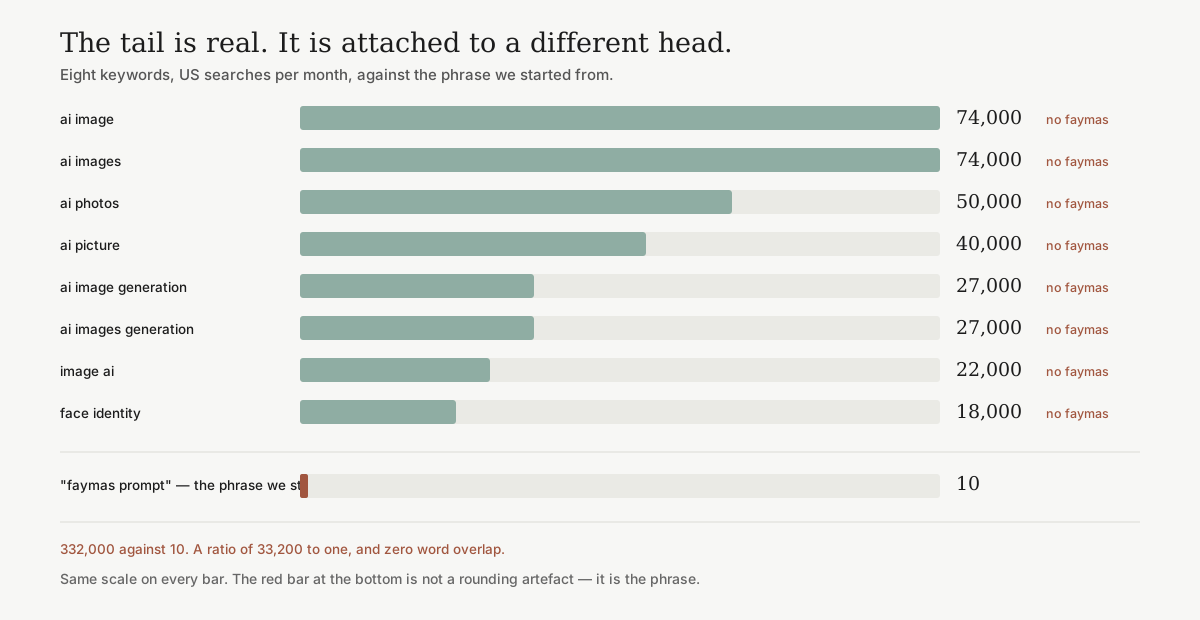
It is real. It is just attached to a different head. The keyword data we hold lists eight words that Google reads out of faymas.in, and none of them contains "faymas".
| Keyword | US searches / month | Contains "faymas"? |
|---|---|---|
| ai image | 74,000 | No |
| ai images | 74,000 | No |
| ai photos | 50,000 | No |
| ai picture | 40,000 | No |
| ai image generation | 27,000 | No |
| ai images generation | 27,000 | No |
| image ai | 22,000 | No |
| face identity | 18,000 | No |
| Total | 332,000 | 0 of 8 |
Three hundred and thirty-two thousand a month against ten. A ratio of 33,200 to one, and zero word overlap. That is the shape of the answer: the tail exists, it is enormous next to the phrase, and the phrase is not a path into it.
A brand word with a real long tail behaves differently — "notion template" extends "notion", "canva resume" extends "canva". Those tails share the head token, which is what makes them tails. Here the extension runs to a completely different vocabulary. The brand is a door that opens onto rooms labelled in somebody else's words.
How to check whether your own keyword has a tail
Four steps. One afternoon, no paid tools.
1. Count the corpus. Pull /sitemap.xml and total the URLs. Under roughly 200, you are not testing a tail — you are testing a brochure.
2. Run the variant test. Write eight to ten longer forms a real user would type and grep the slugs. Most forms returning zero means there is no supply behind the phrase.
3. Signature the matching pages. Fetch each page whose URL matches a variant and hash its item sequence. Identical hashes across different keywords means the keyword lives in the URL and nowhere else.
4. Find the family. Look at what the domain actually draws and sum it. If the sum dwarfs your phrase and shares no token with it, you have a door, not a destination.
Step 3 is the one people skip, and it is the one that decides the question. A URL that matches your keyword proves someone generated a URL. It does not prove anyone assembled a result.
What this means if you are writing for the word
We are. Of the 22 guides on this site, four have "prompt" in the slug. We are not going to pretend we discovered a 10-a-month keyword and pivoted away from it — we are writing into the same thin pool, and the numbers above are the ones we write against.
What would make us change the answer: a monthly series showing the flat bars climbing rather than one spike; variant greps that stop returning zeros; or a keyword source reporting long-tail volume we cannot see from here. None of those has happened. Until one does, the honest status of a faymas long tail is 未查到 / not found — not "small", not "emerging", just not observed.
FAQ
Does "faymas prompt" have a long tail?
No tail was found. Nine plausible longer forms were searched against 15,030 URLs on faymas.in: four forms returned 1–3 hits, five returned zero. The eight keywords that actually drive traffic to the biggest faymas site total about 332,000 searches a month and none contains the word "faymas".
Is 10 searches a month a real number or a rounding artifact?
It is the figure in the keyword data supplied to us for the US market. The accompanying 12-month sparkline is eleven flat bars and one full bar, which suggests a single recent month carries the average rather than a steady baseline. That reading is an inference; monthly values cannot be recovered from a sparkline.
Why is the first-page bid shown as "—"?
A dash is not a zero. A zero would mean advertisers bid and bid nothing; a dash means there was too little advertiser activity to model a price. That distinction is inferred from the field's format — no ad platform threshold was measured.
Do any of the three faymas sites have a page targeting "faymas prompt"?
One usable one: faymas.net/prompts/faymas-ai-prompts, with 1,158 words of text. faymas.in has a page of the same name, but its 20-item grid is identical to the grids on /prompts/ai-images and /prompts/ai-prompts, so the keyword exists only in the URL. faymas-in.com publishes three posts and was not found to have such a page.
Where does faymas.in's traffic vocabulary come from instead?
From generic AI-image terms — "ai image" (74,000/mo), "ai photos" (50,000/mo), "face identity" (18,000/mo) and five others, totalling roughly 332,000 searches a month across eight keywords, none of which contains "faymas".