No. Eleven of the twelve /prompts/ pages on faymas.in render the identical twenty prompt cards, in the identical order, byte for byte. We hashed the card sequence on every page and got one shared signature on eleven of them. Those twenty cards are simply the newest uploads on the site — all created inside a 75-minute window, all in one category, with two copies between them. Only the prose above the grid is written per keyword. The keyword in the URL does no filtering at all.
Twelve keyword collection pages on faymas.in, fetched and compared on 2 October 2026.
What we measured
On 2 October 2026 we pulled the faymas.in sitemap and separated out the twelve URLs under /prompts/. Then we fetched all twelve, decoded the embedded page payload, and pulled the card data out of each one: slug, category, copy count and creation timestamp. Finally we compared the sequences against each other and against the homepage, fetched minutes earlier.
| Measurement | Value | Note |
|---|---|---|
URLs under /prompts/ | 12 | From the sitemap |
| Prompt pages in the same sitemap | 12,367 | 12,425 URLs in total |
| Pages returning 20 cards | 11 | One returns zero |
| Distinct card sequences among the 11 | 1 | Same slugs, same order |
| Copies across those 20 cards | 2 | Highest single value: 1 |
| Categories represented | 1 | All twenty: photography |
| Creation window | 75 minutes | 23:31 to 00:46 UTC, 1–2 Oct |
| Unique prose per page | 846–1,946 words | Intro copy only, excludes the grid |
So each page carries real, individually written text. It just sits on top of one shared grid.
The same twenty cards, eleven times
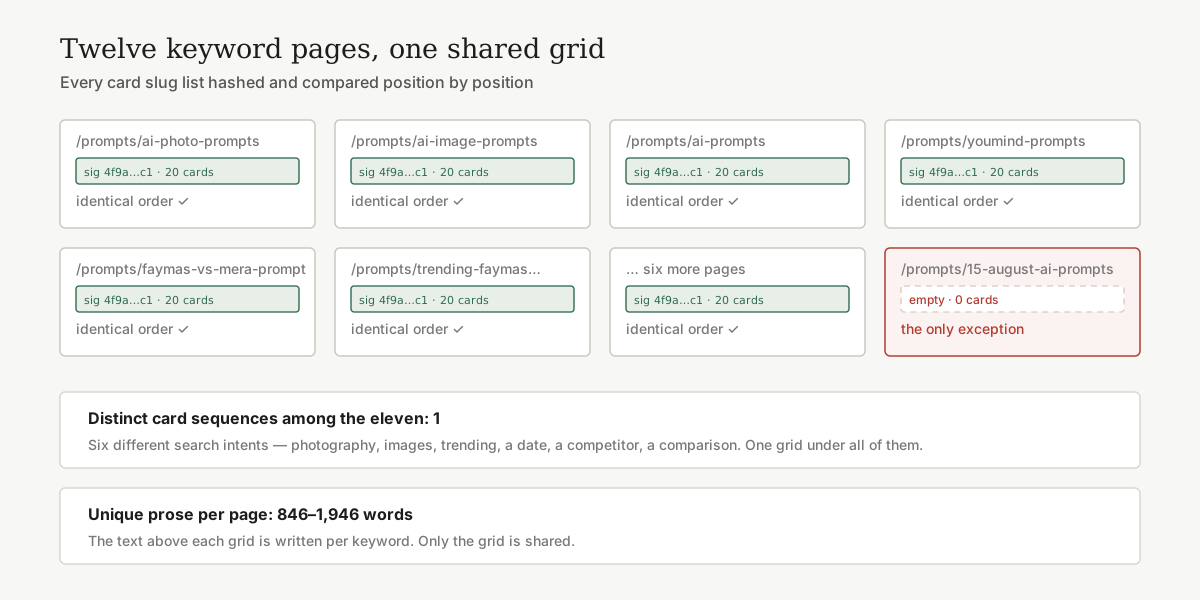
This is not a partial overlap or a strong resemblance. We compared the slug list from /prompts/ai-photo-prompts against the other eleven, position by position. Ten of them match exactly, all twenty positions, no reordering. The eleventh has an empty list.
The pages in question are not variations on a theme, either. They are aimed at genuinely different searches — AI Photography Prompts, AI Images, Trending Faymas AI Prompts, 15 August AI Prompts, and two that target other companies entirely: one on YouMind Prompts, one titled Faymas vs Mera Prompt. Six different intents, one card grid.
What those twenty cards actually are
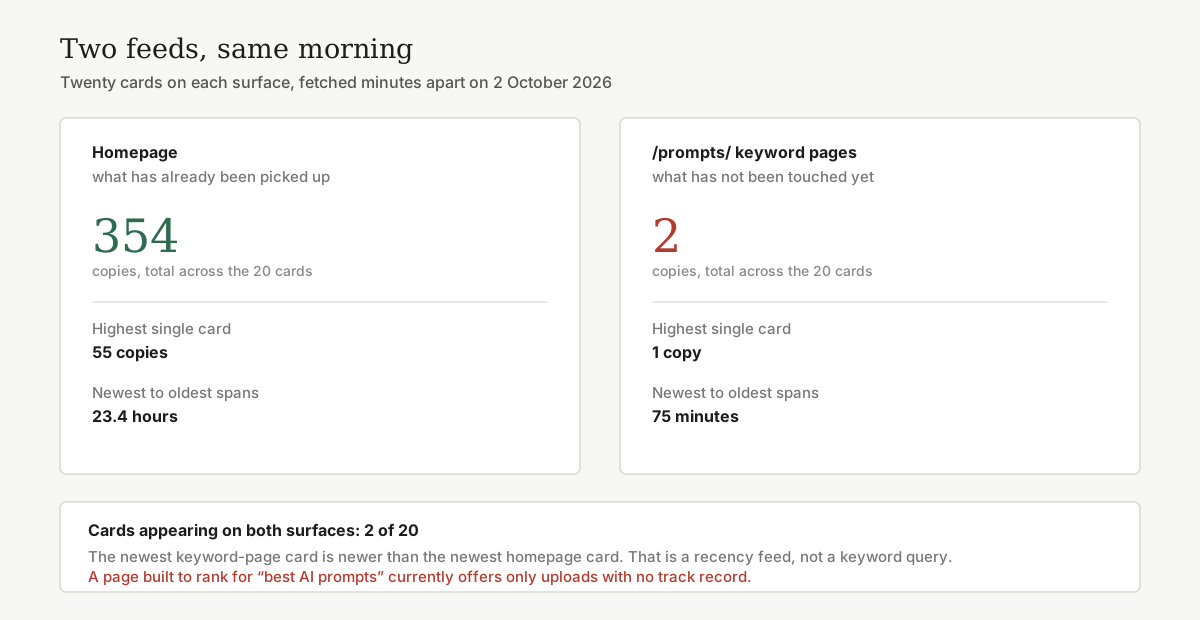
The giveaway is the timestamp. The aggregate cards were created between 23:31 UTC on 1 October and 00:46 UTC on 2 October — a 75-minute slice. The newest of them is newer than the newest card on the homepage, which we fetched minutes earlier and which stopped at 00:15.
That is the signature of a recency feed, not a keyword query. And it is a feed pointed at the quietest corner of the catalogue.
| Surface | Cards | Copies, total | Highest | Created within |
|---|---|---|---|---|
| Homepage | 20 | 354 | 55 | 23.4 hours |
/prompts/ pages | 20 | 2 | 1 | 75 minutes |
Two cards appear on both. The other eighteen are exclusive to the aggregation pages. Read that as a sorting outcome: the homepage is showing prompts that have already been picked up and copied, and the keyword pages are showing uploads that have not been touched yet. Nothing is wrong with new prompts. But a page built to rank for “best AI prompts” is currently the only place on the site where the material with no track record is the entire offer.
The tell is in the heading
Each grid opens under an <h2> built from a keyword field plus the word “prompts”. On several pages the keyword already ends in “prompts”, so the heading doubles: Featured AI Photo Prompts prompts, Featured faymas ai prompts prompts, Featured AI image prompts prompts. The Trending… page says Featured testing prompts.
That doubling is a small thing, but it is honest evidence. Nobody hand-wrote those headings. They are assembled, and the assembly step is the same one that produced the slug. It is the visible seam of a template that generates a page per keyword and then fills the body from a single unrelated query.
The titles promise more than the index holds
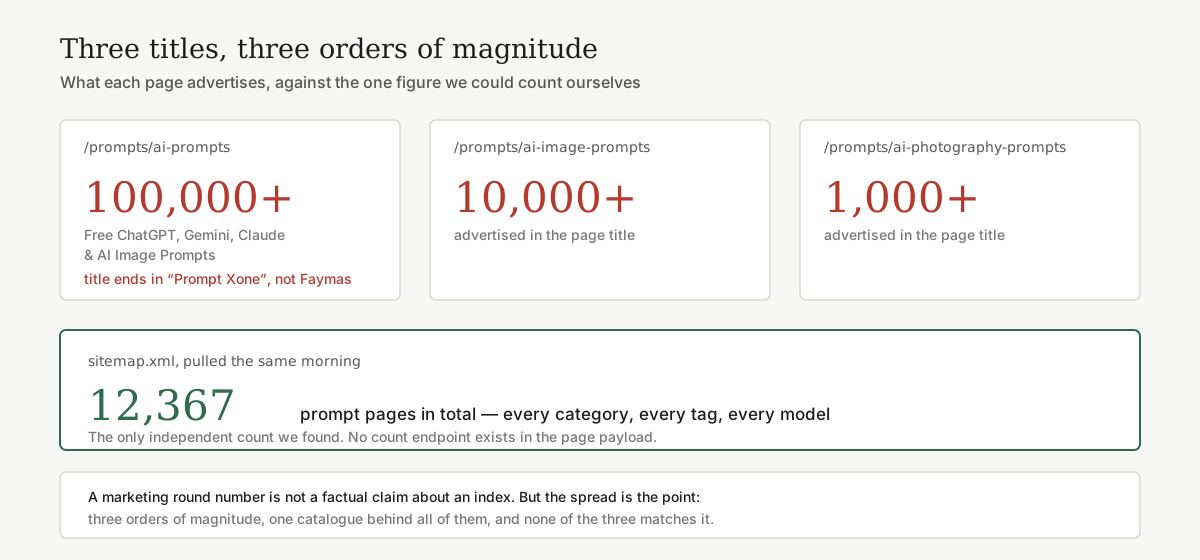
Three of the twelve put a hard number in the title. /prompts/ai-prompts advertises “100,000+ Free ChatGPT, Gemini, Claude & AI Image Prompts”. /prompts/ai-image-prompts says “10,000+”. /prompts/ai-photography-prompts says “1,000+”. The sitemap we pulled the same morning indexes 12,367 prompt pages in total — across every category, every tag, every model.
We are not going to call that a lie; a marketing round number is not a factual claim about an index. But the spread matters. Three pages, three different orders of magnitude, one catalogue behind all of them, and none of the three matches it. The obvious inference — and it is an inference, not something we verified — is that the numbers were chosen to look competitive in a search result rather than read off the database.
One more detail in the same direction. The <title> of /prompts/ai-prompts does not end in the site’s name. It ends in Prompt Xone. Every neighbouring page ends in Faymas or FayMas. Whatever produced that title was not checking the brand string either.
The one page with an empty grid
/prompts/15-august-ai-prompts returns zero cards. It still has six section headings and about 530 words of prose about Independence Day imagery, and it still carries the sitemap entry. It is the only page in the set where the grid collapses.
Two readings fit. Either no prompt in the catalogue matches “15 August”, or the query behind the grid returned nothing for another reason. We cannot separate them from the outside. What we can say is that under a keyword-filtering model, an empty result is the expected outcome for an unmatched term — and under a recency-feed model, an empty result should be impossible. The page is therefore the one place where the two hypotheses diverge, and it is currently the exception rather than the rule.
Nobody links to this cluster
We checked inbound links from the rest of the site. The homepage contains zero /prompts/ links. The blog index contains zero. But the pages link to each other freely: one carries six outbound /prompts/ links, another carries all twelve.
So the cluster is closed on the inside and unlinked from the outside. You cannot reach it by browsing faymas.in. You arrive from a search engine, or you do not arrive. Combined with the recency grid, that suggests these pages were built for the entry point rather than for the visitor — a landing shell whose body happens to be whatever was uploaded most recently.
What to do with this
If you landed on one of these pages from a search result, the page will not narrow anything for you. Scroll past the prose, ignore the grid, and use search or a category page instead; those at least respond to a term you typed. And do not read the card row as a ranking of what is good — it is a queue of what is new, and on the day we measured, the entire queue had been copied twice.
If you publish prompts there, the practical consequence is sharper. Your upload appears on eleven keyword pages for as long as it is among the twenty most recent, then disappears from all of them at once. There is no keyword-matched slot to earn, because there is no keyword matching. The only durable placement on the site is the one the homepage controls, and we have not established how that one is chosen.
What we could not determine
- Whether the shared grid is a deliberate fallback or an unfinished query. Both explain every observation here.
- How long a prompt stays in the twenty. Our snapshots are minutes apart, not hours.
- Whether the homepage feed and this feed are the same component with different parameters. They returned different sets on the same morning, which points to different parameters, but that is inference.
- The real number behind the “100,000+” style titles. We found no count endpoint in the page payload; the sitemap’s 12,367 is our only independent figure.
- Whether these pages bring in traffic at all. We have no access to their analytics.