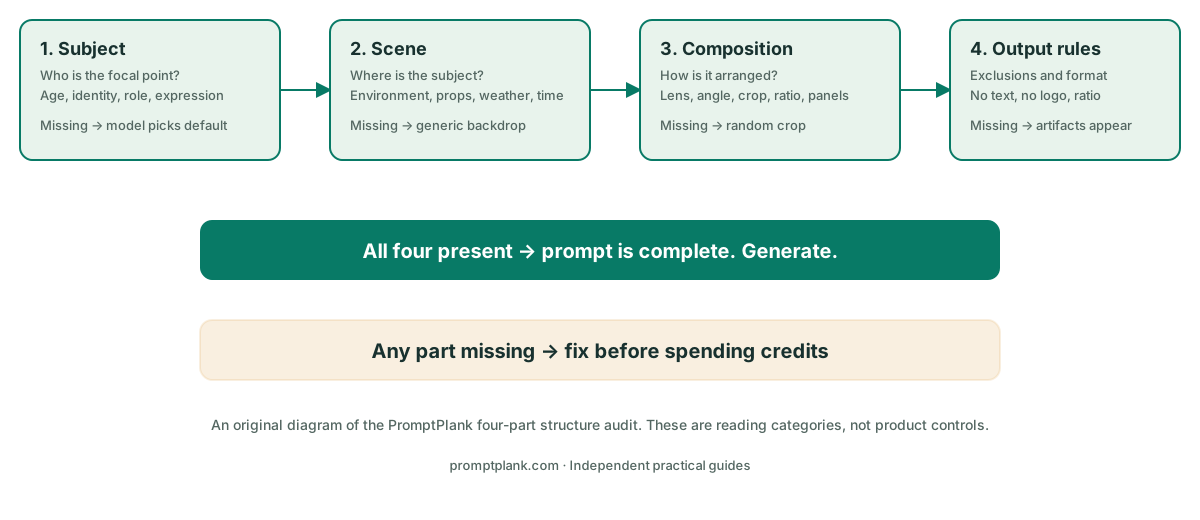
Before generating, check four things: who the subject is, where the scene happens, how the image is composed, and what output rules apply (no text, no watermark, ratio). If any of these four is missing or vague, the prompt is incomplete. Fix it before spending credits—not after a wrong result.
This is a structural reading checklist, not a claim about which AI model produces better images. No generation test was run. The checklist comes from reading published Faymas prompts and competitor pages.
Why competitor pages do not help you audit a prompt
Dreamina, SeaArt and Media.io all publish ready-to-copy Faymas prompts grouped by theme—girl portraits, 80s nostalgia, video hooks, product shots. None of them tells you how to evaluate a prompt you wrote yourself or found outside their platform. The gap is not another list of prompts; it is a method for checking whether a prompt is ready to generate.
The four-part structure audit
Read the prompt once and mark each part. If a part is absent, do not guess the model's intention—add it explicitly or pick a different prompt.
| Part | What to look for | What happens if it is missing |
|---|---|---|
| Subject | Who or what is the focal point. Age, identity, role, expression. | The model picks a default subject that may not match your intent. Common failure: generic face replacement. |
| Scene | Where the subject is. Environment, props, weather, time of day. | The model fills a blank background or copies a style from the example image without telling you. |
| Composition | How the image is arranged. Lens, angle, crop, panel count, ratio. | You get a random crop. Multi-panel prompts may collapse into a single image. |
| Output rules | Explicit exclusions and format. No text, no logo, no watermark, aspect ratio. | Watermarks or readable text appear in the image. The ratio may not match your target platform. |
A prompt that names a subject but leaves the scene to the example output is not necessarily bad. The problem is not knowing which part is delegated. Mark each one so you can trace failures to the right cause.
Worked examples from published prompts
Example A: car-side portrait
A published Faymas prompt asks to retain a person from a reference image and preserve framing, headroom and subject size. All four parts are present: subject (the person in the reference), scene (leaning on a white hatchback), composition (vertical full-body, headroom specified), and an implicit output rule (match the example). Our reading: this prompt passes the audit.
Example B: three-panel portrait
A different published prompt separates the identity photo from a visual reference and assigns clothing, pose and lighting to the second image. Subject is explicit. Scene is delegated to the visual reference, which is named. Composition (three panels) is explicit. Output rules are not stated—no ratio, no exclusion of text. Our reading: the prompt is usable but the output-rules gap should be filled before generating.
What to do when a part is missing
- Subject missing: describe the person or object. Do not rely on the example image's subject unless you are uploading it as a reference.
- Scene missing: add environment, lighting and mood. A subject without a scene produces a generic studio backdrop.
- Composition missing: specify crop, ratio and panel count. If the prompt references a layout, confirm you can supply the layout image.
- Output rules missing: add "no readable text, no watermark, no logos" and the target aspect ratio (16:9, 9:16, 1:1).
Common patterns that mask an incomplete prompt
- Long adjective chains: ten lighting words do not replace a missing scene description. They describe a mood, not a place.
- "Cinematic" as a catch-all: without a lens or angle, "cinematic" tells the model to use a default film look. Add the specific composition.
- Inheriting the example image's framing: if the prompt does not restate the crop, the model may or may not follow it. Write the composition explicitly.
- Style words without output rules: "editorial" and "magazine cover" describe aesthetics, not whether text should appear. Always add exclusions.
Questions before you generate
How long should a Faymas prompt be?
Long enough to cover all four parts. Some published prompts are 15 words; others are 150. Length is not the test—completeness is.
Do I need to copy the style from the example?
Only if the prompt tells you to. If it delegates style to a reference image, you need that image. If you do not have it, mark style as undelegated and add it in words.
What if the prompt is for a different tool than mine?
The four-part structure travels across tools. Parameter names (aspect ratio, negative prompt) differ. Check the tool's documentation for how to express output rules.
For the reference-image checklist, read our reference images guide. This guide is independent and is not affiliated with Faymas.