Not a standalone prompt startup. faymas.in is one domain inside a large, professionally monetised site portfolio. Its own /ads.txt file declares MANAGERDOMAIN=adpushup.com, lists the Google publisher account pub-6644558441501035 as a DIRECT seller, and spreads 826 non-empty lines across 152 different ad exchanges. We then checked ten unrelated utility sites — carsized.com, text-compare.com, epochconverter.io and seven more. All ten carry that same publisher ID in their own ads.txt. The site you are competing with for the word faymas is a node in a bulk keyword operation, not a prompt marketplace built by prompt people.
Three faymas domains, /ads.txt fetched and cross-checked against 13 unrelated sites on 3 October 2026.
What ads.txt is, and why it answers this question
ads.txt is a plain public text file that a publisher puts at the root of its domain. It lists every company authorised to sell that site's advertising space, one per line, each marked DIRECT or RESELLER. It exists so advertisers can check they are buying real inventory.
It is also, accidentally, one of the few honest fingerprints a website leaves behind. Nobody writes it for readers. Nobody optimises it for search. It just states which monetisation machinery the domain is wired into.
On 3 October 2026 we fetched /ads.txt from all three faymas domains and read the results.
Three domains, three completely different files
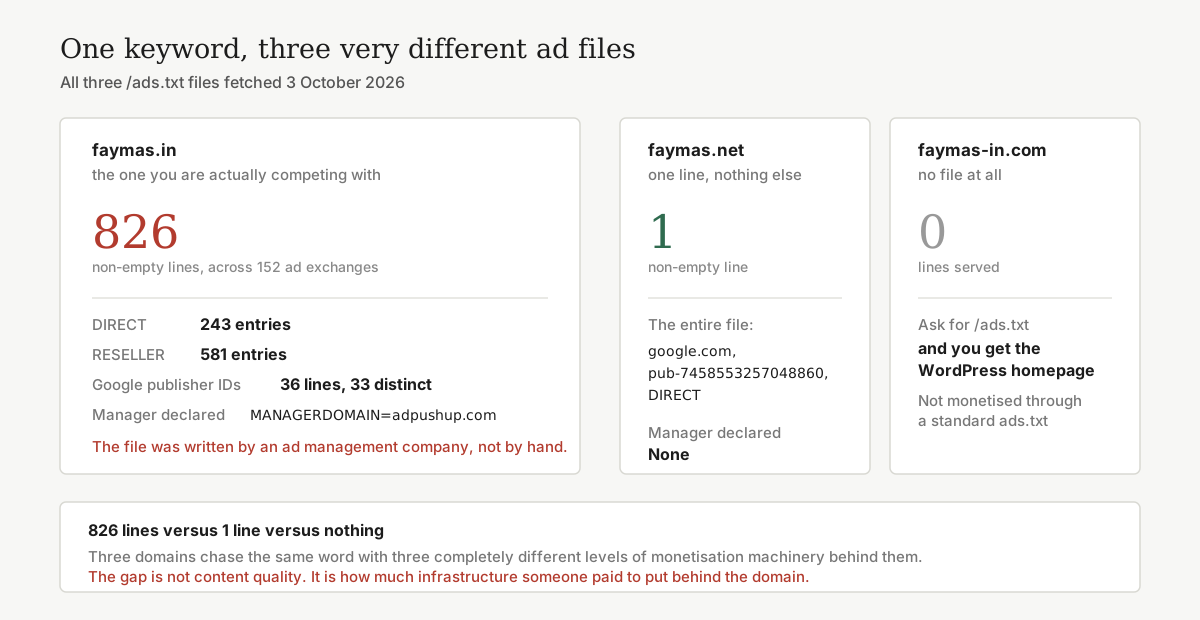
| Measurement | faymas.in | faymas.net | faymas-in.com |
|---|---|---|---|
Valid /ads.txt served | Yes | Yes | No — the URL returns the homepage HTML |
| Non-empty lines | 826 | 1 | N/A |
| Distinct ad exchanges named | 152 | 1 | N/A |
| DIRECT entries | 243 | 1 | N/A |
| RESELLER entries | 581 | 0 | N/A |
| Google publisher IDs listed | 36 lines, 33 distinct | 1 | 0 |
| Manager domain declared | adpushup.com | None | N/A |
The spread is not subtle. One file is 826 lines. The next is a single line — google.com, pub-7458553257048860, DIRECT, and nothing else. The third domain does not serve an ads.txt at all; asking for it returns the WordPress homepage instead.
Three sites chasing the same word, three entirely different levels of monetisation infrastructure.
We tested the network claim ourselves
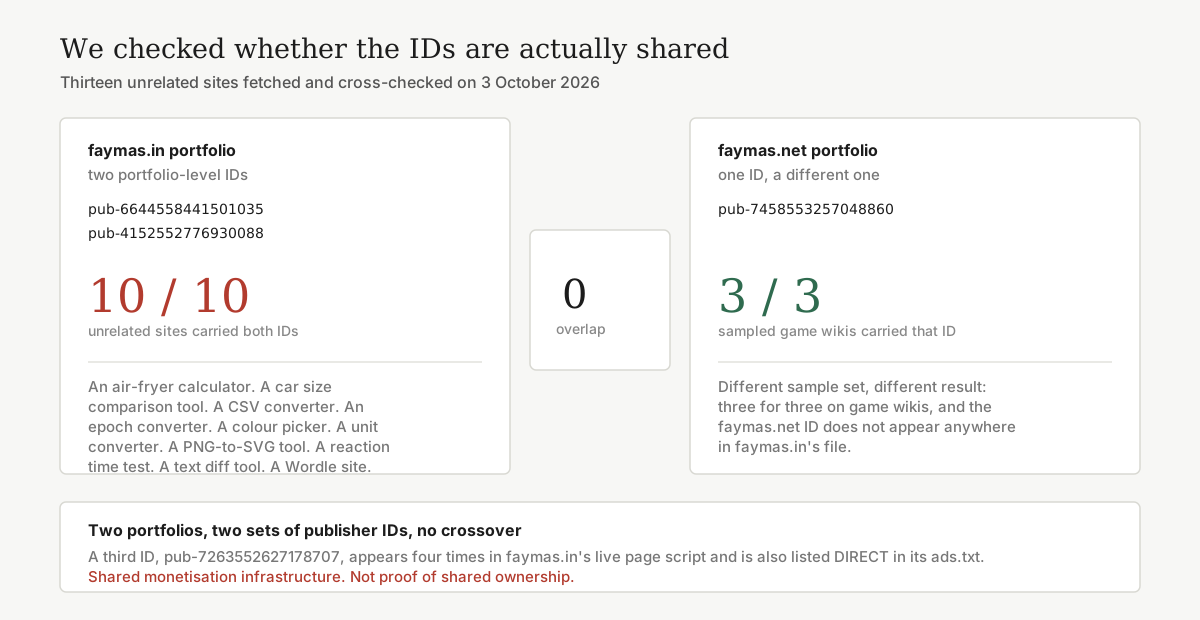
A shared publisher ID is only interesting if it is actually shared. So we checked.
We pulled the ads.txt of ten sites that have nothing to do with AI prompts — an air-fryer calculator, a car size comparison tool, a CSV converter, an epoch timestamp converter, an image colour picker, a unit conversion site, a PNG-to-SVG tool, a reaction time test, a text diff tool and a Wordle fan site. Ten for ten, every single file contained both pub-6644558441501035 and pub-4152552776930088. The same two IDs listed DIRECT on faymas.in itself.
We ran the same test on the other side. faymas.net's single ID, pub-7458553257048860, turned up in the ads.txt of three game wiki domains we sampled. Three for three. And faymas.in's file does not contain faymas.net's ID anywhere — zero matches. Two separate operators, two separate portfolios, no overlap.
One more detail worth noting. The publisher ID that actually appears in faymas.in's live page script — four times — is a third one, pub-7263552627178707. It is also listed DIRECT in the ads.txt. So the domain is wired into at least three Google accounts at once: two portfolio-level IDs and one page-level ID.
What a long ads.txt does and does not prove
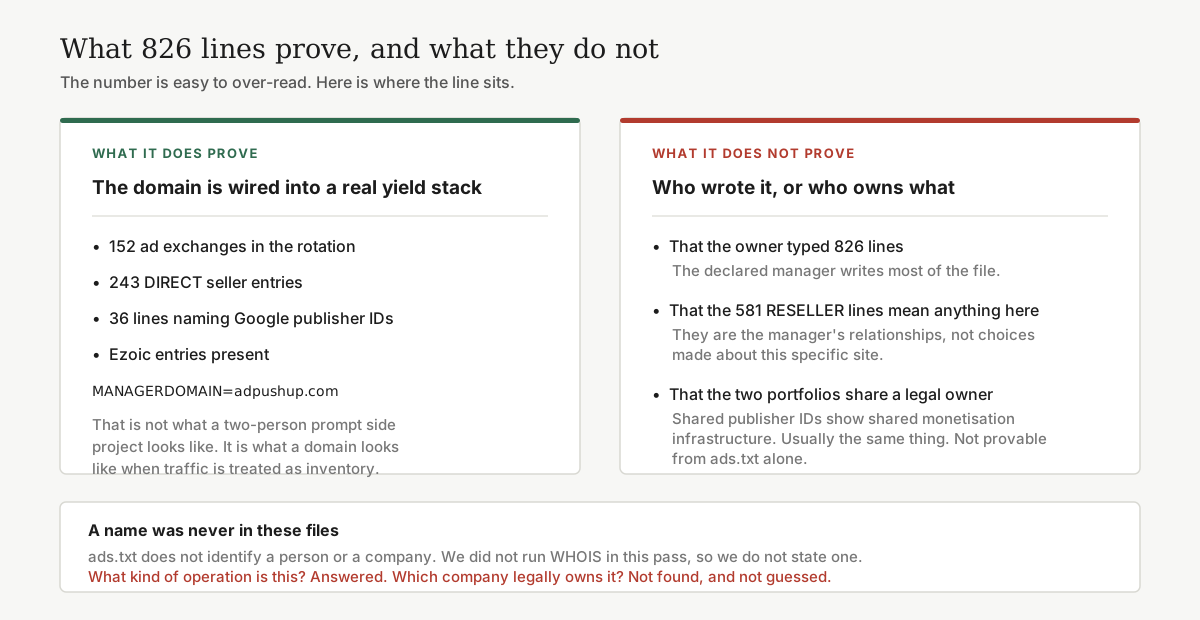
Be careful here, because the number is easy to over-read.
A long file does not mean the site owner sat down and typed 826 lines. Almost certainly they did not. When a publisher signs up with an ad management company, that company writes most of the file on their behalf. The 581 RESELLER entries in particular are the manager's reseller relationships, not choices made about this specific site.
What it does prove is narrower and still useful: this domain has been plugged into a professional yield-optimisation stack. Ezoic entries, AdPushup as declared manager, 152 exchanges in the rotation. That is not what a two-person prompt side project looks like. That is what a domain looks like when someone is treating traffic as inventory.
It also does not prove the sites share an owner in any legal sense. A shared publisher ID proves shared monetisation infrastructure. Those two things usually travel together, but ads.txt alone cannot establish it.
Why the operator's shape matters more than the operator's name
Here is the part that actually changes what you should do.
A portfolio operator buys keywords by volume. Their unit of work is a page that can hold a keyword, not a prompt that a person will use. That prediction matches what we have already measured on the site itself: 12,708 pages under /prompt/ in a single sitemap, and twelve keyword collection pages under /prompts/ that render the identical twenty cards in the identical order, keyword or no keyword. Only about 0.9% of the catalogue is reachable by browsing. The pages exist to be indexed, not to be read.
None of that is a scandal. It is just a different game from the one you might assume you are playing. You are not losing to better prompts. You are losing to better index coverage.
Which also tells you where the openings are. Bulk portfolios are thin exactly where volume economics do not pay: questions that need a specific answer, comparisons that need somebody to actually fetch and compare, anything requiring a number you have to go and measure. The three-way ads.txt contrast in the table above took one morning to produce and appears on no other page. That is the shape of the gap.
What we could not find
A name. ads.txt never identifies a person or a legal entity, and nothing in these three files did either. We did not run WHOIS in this pass, and there is no public company registration tied to the domain that we could locate from the ad files alone.
So if the question is "which company legally owns faymas.in" — not found, and we are not going to guess at it. If the question is "what kind of operation is this domain attached to", the ad files answer it clearly, and the answer is a bulk monetisation portfolio managed by AdPushup with at least three Google publisher accounts in play.
The practical read
Three domains share this keyword. One is wired into a 152-exchange monetisation stack and sits in a portfolio that includes unit converters and reaction-time tests. One has a one-line ads.txt and sits in a portfolio of game wikis. One is not monetised through a standard ads.txt at all.
That is not a competitive field of three prompt marketplaces. It is one incumbent running an inventory operation and two much smaller properties trailing it. Compete with the first by being specific where it is templated, and measured where it is estimated. Do not compete with it on page count — that fight was decided before you arrived.