Before you publish a Faymas prompt or the image it produced, answer three questions: who owns the output (the tool's terms, not the prompt text, decide this), what does that tool's license allow commercially, and what must you disclose. The prompt you wrote is yours; the generated image's ownership follows the AI tool's terms. Read both before you post.
This guide maps ownership and license limits for four AI tools based on their published terms as of March 2026. It is editorial analysis, not legal advice. Terms change; verify the current policy on each tool's official site before publishing commercially.
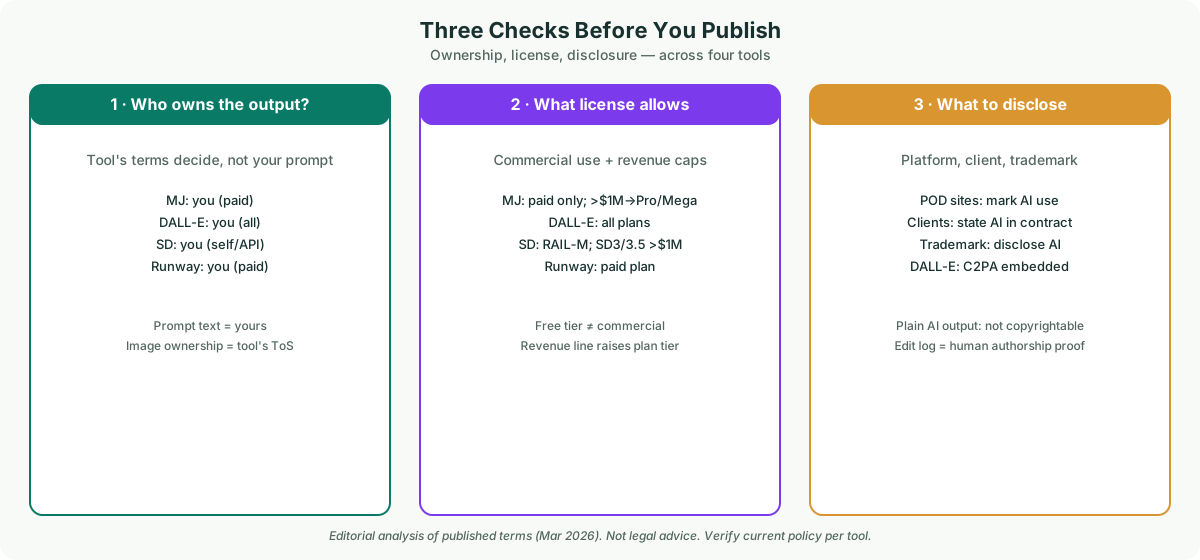
Check 1: Who owns the output
The prompt text you write is yours. The image the AI produces is a different asset, and its ownership is decided by the tool's terms of service, not by your prompt. Across the four tools we cover:
| Tool | Who owns the output | Key condition |
|---|---|---|
| Midjourney | You (paid plans) | Free trial is CC BY-NC 4.0—no commercial rights. Paid plans grant ownership "to the fullest extent permitted by law." |
| DALL-E 3 | You (all plans) | OpenAI assigns all rights to you. Free and Plus may use your content for training; Business/Team/API do not. |
| Stable Diffusion | You (self-host or API) | CreativeML Open RAIL-M (SD 1.5/SDXL) or Community License (SD 3/3.5). Ownership is yours either way. |
| Runway | You (paid plans) | Commercial use requires a paid plan. Check current terms for the specific model. |
"Owning the output" means the tool gives you the right to use it. It does not mean the image is automatically copyrightable—see Check 3.
Check 2: What the license allows commercially
Ownership and commercial permission are not the same thing. A tool may give you the output but restrict how you use it. The revenue thresholds below are the part most creators miss:
| Tool | Commercial use | Revenue threshold | Restricted uses |
|---|---|---|---|
| Midjourney | Yes (paid) | Companies over $1M revenue must use Pro or Mega | No copyright characters; no passing output off as your own drawing |
| DALL-E 3 | Yes (all plans) | None stated | No named people, no living-artist styles, no deepfakes |
| Stable Diffusion | Yes (RAIL-M) | SD 3/3.5 free only under $1M revenue; SD 1.5/SDXL unlimited | No illegal content; no training competing models; no misrepresentation |
| Runway | Yes (paid) | Check plan terms | No misuse of generated video; follow platform policy |
Two patterns repeat: (1) free tiers are not for commercial publishing, and (2) once your organisation crosses a revenue line, the required plan jumps. If you publish Faymas prompts that produce images you later sell, confirm your plan covers that revenue.
Check 3: What you must disclose
Even when you own the output and the license allows commercial use, disclosure obligations can still apply. These come from three places:
- Platform rules: Print-on-demand sites (Redbubble, Society6, Amazon Merch) may require or recommend marking AI use. Amazon Merch has removed unmodified AI images.
- Client contracts: If you deliver AI-assisted work to a client, state the AI use in the contract. Agencies should update standard agreements to name the tool, IP ownership, and who carries infringement risk.
- Trademark filings: A logo generated with AI and filed as a US trademark may need to disclose AI involvement, and only the human-created elements get protection.
DALL-E 3 images carry C2PA metadata marking them as AI-generated. Midjourney and Stable Diffusion do not embed this by default, so the disclosure is on you if the platform or client requires it.
The copyright gap that applies to all four
Plain AI output is likely not copyrightable. Under the 2025 U.S. Copyright Office guidance and the Thaler v. Perlmutter ruling, content without human authorship cannot be registered. This means: you can use the image commercially (the tool's contract says so), but you generally cannot stop someone else from copying it. The protection comes from your human creative contribution—substantial editing, compositing, or direction—not from the generation step.
This is why keeping a record matters. Our prompt output record guide explains saving the exact prompt, inputs, tool, and edits. For copyright purposes, the edit log is the evidence of human authorship.
Three traps before you publish
Trap 1: Assuming the prompt owns the image. The prompt is your text. The image's ownership follows the tool's terms. Writing a great prompt does not make you the copyright holder of the pixels.
Trap 2: Publishing free-tier output commercially. Midjourney's free trial is CC BY-NC 4.0. Posting that image on a product page violates the license. Confirm your plan tier before monetising.
Trap 3: Copying a competitor's example as your own. Faymas and competitor pages show example outputs. Those images belong to whoever generated them under that tool's terms. Re-posting another creator's example as your result is both an ownership error and a disclosure failure.
Questions before you publish
Can I sell a Faymas prompt I wrote?
The prompt text is yours to publish or sell under Faymas's creator terms. Whether the example image you show can be sold depends on the AI tool that produced it—run Checks 1–3 on that tool first.
Do I need to tell buyers an image is AI-generated?
If you use DALL-E 3, the C2PA metadata already marks it. For other tools, platform and client rules decide. When in doubt, label it "AI-assisted" rather than present it as fully hand-made—hiding AI use hurts trust and may breach a contract.
What if I edit the image heavily in Photoshop?
Substantial human editing is the strongest path to copyright protection. Keep the edit history. The more creative direction and transformation you add, the more your human contribution can qualify for protection separate from the AI step.
For the record-keeping method, read our prompt output record guide. For adapting prompts across tools, see our cross-model adaptation guide. This guide is independent and is not affiliated with Faymas or any tool mentioned. It is not legal advice—verify current terms on each tool's official site.